
Game Development
46 courses8 categories
Part of LearnCreative
Game development is one of the broader topics in software because the term covers studios of three to three hundred people, projects from a 2D mobile puzzle game to a AAA open-world title, and an unusually wide range of disciplines packed under "engineer". A single game engineer might write rendering code, build gameplay systems, optimize for the GPU, integrate analytics, and ship to the App Store, Play Store, Steam, PlayStation, Xbox, and Nintendo Switch within the same month.
The engine choice usually anchors everything else. Unity covers most indie 3D, mobile, and VR/AR work and ships C# scripting plus a deep asset-store ecosystem. Unreal Engine handles the higher-fidelity end — AAA games, virtual production for film, automotive visualization — using C++ and Blueprints. Godot has matured into a credible Unity alternative for 2D and lighter 3D with GDScript or C#. Custom engines are still common at large studios but rarely the right choice elsewhere.
What you'll find under this topic
- Engines: Unity, Unreal Engine, Godot, custom engines
- Graphics programming: shaders (HLSL, GLSL), lighting, post-processing, real-time rendering
- WebGL and Three.js for 3D in the browser, plus the emerging WebGPU stack
- Game-physics: rigid body, particle systems, character controllers, ragdolls
- Animation: skeletal rigging, blend trees, IK, root motion, state machines
- Networking: lockstep, client-side prediction, rollback netcode, lobby systems
- Game math: vectors and matrices, quaternions, easing curves, the math that shows up
- Shipping: profiling, asset budgeting, build automation, store-specific submission flows
The entry path into the industry changed in the last decade. The expected starting point is shipping a small game (game jams, itch.io releases, Steam Early Access) before applying to studios. The portfolio matters more than the credential. Compensation lags general software engineering at the junior end but converges by senior+, especially at studios with successful releases.
Categories(8)


Courses(46)
Showing 1–30 of 46 courses
 NewIn the course, you will create a full-fledged 2D game in Unity, master working with physics, controls, collisions, and interface, gaining practical experience.6h 40m
 NewMaster Unity DOTS and create large-scale games with high performance. The course will help you learn ECS, Job System, and Burst for complex projects.18h 40m
 NewThe course will help you master the key tools of Unity and learn over 70 features of the engine to accelerate development and improve workflows.16h 31m
 Updated 1mo agoMaster Unity from scratch and create a full-fledged 3D Tower Defense game by learning enemy AI, tower mechanics, UI, and project logic in a practical bootcamp.13h 22m
 Updated 1mo agoLearn TresJS to build interactive 3D scenes in Vue: objects, lighting, animation, model loading, and reactive, user-driven controls.52m
 Updated 1y agoLevel up your game development skills by creating your own version of the classic arcade game Asteroids using Unity.5h5/5
 Updated 1mo agoGame math made practical: trigonometry, vectors, matrices, quaternions, and interpolation, tied to real game-dev problems.6h 5m
 Updated 1y agoThis course is designed for developers who want to learn how to create impressive visual effects.20h 11m
 Updated 1y agoStart with the basics of Three.js and gradually move on to advanced topics such as streaming infinite worlds, GPU memory optimization.47h 38m
 Updated 1y agoDreamed of creating your own video game but didn't know where to start? You've come to the right place.10h 11m
 Updated 1y agoUnleash your creative potential with the Vanilla Three.js course from JSMastery.pro - the perfect choice for beginners and developers looking to create.31m
 Updated 1mo ago27-lesson advanced HTML5 game dev course: build a Canvas-based breakout game with CreateJS, audio, controls, and data storage.2h 19m
 Updated 1mo ago43-lesson Godot course focused on coding responsive side-view character movement for platformers and Metroidvania-style games.5h 20m
 Updated 2y agoSo you're trying to learn Godot Engine. You've been digging through YouTube videos but there aren't as many learning resources as other engines like Unity or Ga16h 50m
![[PRO] Make Professional 2d Games with the Godot Game Engine thumbnail](https://cdnq.courseflix.net/course/thumbnail/pro-make-professional-2d-games-with-the-godot-game-engine-160x90.webp "[PRO] Make Professional 2d Games with the Godot Game Engine thumbnail") Updated 1mo ago148 standalone chapters on building a Zelda-inspired 2D game in Godot 3.0: advanced features, best practices, and 2D mechanics.23h 26m
Updated 1mo ago148 standalone chapters on building a Zelda-inspired 2D game in Godot 3.0: advanced features, best practices, and 2D mechanics.23h 26m Updated 1mo ago92-lesson Lua course from scratch: core language basics, embedding Lua inside C programs, and a bonus intro to Lua in Roblox Studio.13h 34m
 Updated 2y agoLearn to build 60 games in Construct 2 without coding. Master game development by building 60 practical projects. Learn to make art and design games in Photosho34h 13m
 FreeUpdated 2y agoThis course will have you integrate graphics, and write c# scripts to create a very popular mobile game. You will go through every single step of the developme14h 7m
 Updated 2y agoThis course is about the creation of VFX for Games with Unity Visual Effect Graph. You will start learning VFX Graph from scratch by creating some sparks. Then4h 17m
 Updated 1mo agoIntermediate Unity course focused on problem-solving: compare coding approaches, think like a programmer, and optimize from day one.24h 3m
 Updated 1mo agoVol. 1 of a step-by-step Unity guide: go from an empty project to a playable game while learning C#, AI, animation and optimization.28h 1m
 Updated 2y agoUsing Unity 2020.1, we’ll show you how to include two essential game mechanics, dialogue and quests, in your games. This highly acclaimed series was over 200% f12h 34m
 Updated 1mo agoFast, step-by-step Three.js and WebGL crash course: build interactive 3D scenes for the web, with full source code included.1h 32m
 Updated 2y ago3D development is a vast field with many different techniques. This comprehensive guide will give you the necessary tools to get started and resources to.9h 18m5/5
 Updated 1mo agoAdd shops, special abilities, and character traits to a Unity RPG project, building each system hands-on with intermediate-level C# coding.18h 51m
 Updated 2y agoLearning the fundamentals of Unity Android Game Development puts a powerful and very useful tool at your fingertips.16h 50m
 Updated 2y agoFull Time Game Dev will take you from knowing nothing about game development to making money from your indie game on the Steam store.35h 12m
 Updated 2y agoLearn the Blender techniques I use daily to create a content for 200K+ audience and serve global brands. Uplevel your Blender skills and unleash your creative p24h 9m
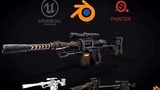 Updated 1mo agoModel, texture, rig, and export a sci-fi sniper rifle in Blender 3.4 and Substance Painter, built as one complete game-asset workflow.4h 58m
 Updated 2y agoThe course has been remastered in Unity 2018! This course started as a runaway success on Kickstarter and has gone on to become the most popular and most watche18h 17m
Related topics
Frequently asked questions
- Unity vs Unreal vs Godot — which engine should I learn?
- Unity still has the largest indie and mobile market, the most jobs, and the most learning resources; the licensing changes of 2023–2024 hurt sentiment but adoption stuck. Unreal owns AAA, high-end visuals, and most studio hiring. Godot is the fast-growing open-source choice, great for solo developers and 2D projects, but with a smaller paid market.
- Do I need to learn C++ to work in games?
- Yes for AAA and Unreal-engine work, where C++ is the production language and performance is non-negotiable. No for Unity (C#), Godot (GDScript or C#), or most mobile and indie work. If you want studio jobs at the top end plan on C++ plus engine internals; if you want indie or mobile, a higher-level language is fine.
- Is indie game development a realistic career?
- Realistic but financially risky. Most published indie games don't earn back their development time; the ones that succeed often took years of part-time work first. Treat indie as a long-term creative bet, keep a day job until traction is real, and study marketing as seriously as engine work — discoverability kills more indie projects than code does.
- What math do I need for game development?
- Vectors, matrices, basic trigonometry, and dot/cross products for 3D work. A little linear algebra. Physics is bundled into modern engines, but understanding what's under the hood (forces, integration, collision response) helps when defaults fight your game. Calculus and deeper math only matter for graphics-programming or physics-engine work.
- How long until I can ship a game?
- A small playable prototype is weeks; a polished short game is 6–12 months part-time; a commercial release of meaningful scope is years. Scope discipline matters more than engine choice. Most successful first releases are deliberately small — one core mechanic, one core loop, focused art — rather than ambitious genre mashups.