Learn data science and AI online
Data & AI
6 topics under this pillar
Data and AI is the pillar that turns raw events, transactions, and documents into something a model or a person can act on. It covers the full path from a CSV file you opened this morning to a fine-tuned LLM serving recommendations in production — analytics, machine learning, the modern LLM stack, and the database layer underneath all of it.
The 2026 picture is unusual: the field has split into two complementary worlds. Classical ML — gradient-boosted trees, regression, feature engineering on tabular data — still drives the majority of business value at banks, insurers, marketplaces, and operations-heavy companies. Meanwhile generative AI and LLM engineering have created a parallel discipline focused on prompts, retrieval, evals, and agent loops. The good news is that the foundations (Python, SQL, statistics, linear algebra basics) carry across both. The pillar reflects that — you'll find ML, LLMs, prompts, databases, and the broader AI topic surfaced as siblings.
What you'll find under this pillar
- Machine learning — supervised and unsupervised methods, deep learning, PyTorch and scikit-learn, the math you actually need
- LLM engineering — building with OpenAI, Anthropic, and open-weight models, retrieval-augmented generation, evals, agent patterns
- Prompt engineering — the practical craft of getting reliable structured output from current models
- Databases — PostgreSQL, MySQL, NoSQL, vector stores, query optimisation, schema design
- Applied AI — the broader topic that bundles model selection, fine-tuning, deployment, and the systems work around production AI
The order on this page is intentional. Machine learning sits first because it remains the most transferable skill across employers — every product team eventually wants to predict something, and ML is the answer that compounds. LLM engineering sits next because it has the steepest career-growth curve right now. Prompt engineering is the smallest and most practical of the topics: short courses, immediate payoff. Databases and the AI catch-all topic close the pillar — both are wide, both are heavily searched, and both are where senior data engineers spend most of their time.
Data and AI roles in 2026 hire across an unusually wide range of titles: data analyst, analytics engineer, data engineer, ML engineer, applied scientist, research engineer, AI engineer, ML platform engineer. The boundaries between them blur depending on company size. The shortest path to your first role is usually analytics-engineer style work (SQL, Python, dbt) plus a small portfolio piece using a real public dataset; from there the pillar's topics let you angle towards ML, LLMs, or platform work as you find what you enjoy.
Browse by topic(6)



Featured data & ai courses
 FreeClassic
100 Days of Code - The Complete Python Pro Bootcamp for 2023
 Updated 3y ago
Apache Flink
 FreeClassic
The Ultimate Django Series: Part 1
 Classic
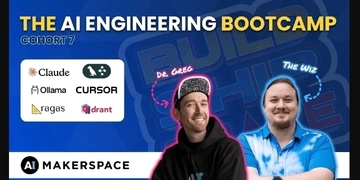
The AI Engineering Bootcamp
 Classic
Mastering Postgres | The most comprehensive course on PostgreSQL
 Updated 7mo ago
Tactical Agentic Coding - Agentic Engineer
 Updated 1mo ago
AI Engineering Bootcamp: RAG (Retrieval Augmented Generation) for LLMs
 Updated 5mo ago
Agentic AI Engineering Course
 Updated 8mo ago
ClaudeKit - Ship Production Features in Hours, Not Weeks
 Classic
High Performance SQLite
 Updated 3y ago
Node.js, Express, MongoDB & More The Complete Bootcamp 2023
 Updated 1mo ago
AI Coding for Real Engineers
Frequently asked questions
- Do I need a CS or stats degree to break into data?
- No, but you'll need to demonstrate the same skills the degree would have given you. Hiring managers look for fluent SQL, comfortable Python, a working grasp of statistics (sampling, hypothesis tests, confidence intervals), and one finished project that solved a real-looking question end-to-end. Degrees still help for research-engineer and applied-scientist roles at frontier labs. For analytics, analytics-engineering, and the majority of ML engineering roles, a portfolio plus the right take-home performance is what gets you to a final round.
- Should I learn classical machine learning or jump straight to LLMs?
- Learn classical ML first if you have any flexibility on timing. The fundamentals — train/test splits, overfitting, regularisation, evaluation metrics — transfer directly to LLM work and will save you from a class of mistakes that have nothing to do with prompts. Two months on supervised learning with scikit-learn, plus one Kaggle-style finished project, is a reasonable floor before pivoting to LLM engineering. If you're already a working engineer who just needs to ship a RAG feature this quarter, skip ahead — but circle back to the fundamentals within a year.
- What's the difference between prompt engineering and LLM engineering?
- Prompt engineering is the craft of getting reliable behaviour out of a single model call — wording, structure, examples, output format. LLM engineering is the broader discipline that wraps prompts inside a real system: retrieval, evals, observability, fallback chains, agent loops, and the production infrastructure around all of it. Most working roles are LLM engineering with a strong prompt-engineering subskill. Pure prompt-engineering courses are short and high-leverage; the LLM engineering tracks on this pillar are where the longer, system-level material lives.
- How important is SQL for data and AI roles in 2026?
- Still critical, and probably more important than the generative-AI hype cycle suggests. Every data role still pulls from a warehouse or operational database, and analytical SQL — window functions, CTEs, query plans — is the single skill that crosses analyst, analytics engineer, data engineer, and ML engineer roles uniformly. The Databases topic on this pillar covers it alongside the design and operations side. If you can only learn one thing this month and you're targeting a data job, make it SQL.
- Will LLMs make traditional ML obsolete?
- No. They've absorbed natural-language and some vision tasks, which is significant, but the majority of business-critical predictions still run on tabular data — fraud scoring, customer churn, demand forecasts, pricing, credit decisions — where gradient-boosted trees and similar classical methods remain faster, cheaper, more accurate, and more interpretable than any LLM. Job postings reflect this: classical-ML roles are not disappearing. What's changing is that more teams now also need someone who can integrate an LLM where the inputs are unstructured text, which is why the pillar covers both sides.
- How long does it take to become job-ready in data?
- Six to nine months of consistent study (an hour a day or two evenings a week) is enough for an analytics-engineer or junior-analyst role if you finish one substantial portfolio project on a real dataset. ML engineering is closer to 12–18 months because the math and the systems work both take time. LLM-engineering roles can come faster — three to six months — if you arrive already comfortable with Python and APIs, since most of the work is system design rather than new fundamentals.