
Career & Soft Skills
53 courses3 categories
Part of LearnBusiness
Career and soft skills covers everything that determines whether a technical career actually compounds — interviewing, communication, negotiation, management, public speaking, writing, and the non-tech domains (finance, law, design) that surround engineering work. Most engineers underinvest here for a decade before realizing that the people who get staff and principal titles are not always the strongest coders; they are the ones who can explain trade-offs, write clearly, and lead a project without micromanaging it.
The hiring market in 2026 rewards this skill set more visibly than ever. Coding-interview rounds have shortened as AI assistants normalize day-to-day implementation work; system-design, behavioral, and architectural-judgment rounds have expanded. Internally, the engineers who move up tend to be the ones who can run a design review, write a clear RFC, and disagree without making it personal.
What you'll find under this topic
- Technical interviewing: data structures, system design, behavioral, salary negotiation
- Resume and portfolio: GitHub, LinkedIn, personal sites that actually generate inbound
- Communication: writing RFCs, design docs, incident postmortems, async-first habits
- Public speaking: conference talks, internal demos, video and screencast production
- Engineering management: 1:1s, performance reviews, hiring, running projects
- Non-tech adjacent skills: business basics, finance fundamentals, contracts and IP
- Time management and focus: deep-work practice, calendar hygiene, productivity systems
This topic applies regardless of where in the stack you work. A senior engineer at Stripe, a freelance contractor, a startup CTO, and a backend lead at a bank all benefit from the same underlying skills — and most of them learned these on the job rather than in school, which is exactly why the courses here matter.
Categories(3)


Courses(53)
Showing 1–30 of 53 courses
 Updated 3mo agoBuild a successful career in AI: from Junior to Senior. Learn popular strategies, create a personal brand, and acquire valuable skills for growth.5h 2m
 Updated 3mo agoThe practical course helps engineers increase their impact in the company by improving communication and linking technical solutions with business value.9m
 Updated 5mo agoLearn how meditations help developers recover after screen time and complex tasks. Practical sessions for improving mental clarity.45m
 Updated 6mo agoThe original course on system design from Educative by DesignGurus. Real cases, frameworks, and videos will help prepare for interviews at FAANG and other compa15h 19m
 Updated 7mo agoLearn to identify true needs and choose the appropriate technology stack. Practical scenarios and working with legacy code will help improve skills.2h 34m
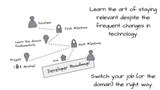 Updated 8mo agoA course for programmers who want to build a successful career in IT. Learn how to choose technologies, develop a growth strategy, and avoid burnout.
 Updated 8mo agoThis photography course is designed to teach you the ins and outs of photography, even if you have little to no experience with it, to help create profitable im74h 1m
 Updated 1mo agoA week-long project course walking through a from-scratch Raft consensus implementation, covering networking, threading, and system design.34h 26m
 Updated 10mo agoDeepen your knowledge in software development. Learn Rust and Go, multithreading, virtualization with Docker, and create modern applications with WebAssembly.8h 3m
 Updated 1y agoThe course "Fundamental Principles of Software Development for Middle Developers" serves as a seamless progression from the beginner's program.5h 2m5/5
 Updated 1y agoEmbark on Your Software Engineering Journey with Strong Foundations In the world of software engineering, possessing a robust knowledge base is crucial.14h 43m5/5
 Updated 1y agoCodeBreakthrough Vault is an exclusive course designed to take you to a new level in your life and career as an engineer.62h 23m5/5
 Updated 1y agoEffortless Screencast Editing with ScreenFlow "ScreenFlow for Screencasters" is designed to streamline your video creation process.1h 22m
 Updated 1y agoDo you work hard, but your results don't match your efforts—whether it's a promotion, a good rating, a raise, or simply the recognition you truly deserve?2h 43m
 Updated 1mo agoLearn a calm, structured approach to debugging: prioritize bugs, build a mental model, and share fixes your team can trust.2h 6m5/5
 Updated 1y ago"Principles and Methods of Decision Making for Leading Engineers" is an advanced course for developers aiming to enhance their skills in teamwork.1h 13m
![Learning to Think [Cognitive Bias] thumbnail](https://cdnq.courseflix.net/course/thumbnail/learning-to-think-cognitive-bias-160x90.webp "Learning to Think [Cognitive Bias] thumbnail") Updated 1y agoExplore how cognitive biases —such as confirmation bias, anchoring effect, and survivorship bias—shape your decisions.34m
Updated 1y agoExplore how cognitive biases —such as confirmation bias, anchoring effect, and survivorship bias—shape your decisions.34m Updated 2y agoLearn how to pass real coding interviews with clear steps and direct guidance from ex-Google and ex-Facebook engineers Patrick Shyu and Jonathan Ma .8h 16m5/5
![Learning to Make Better Decisions [Decision-Making] thumbnail](https://cdnq.courseflix.net/course/thumbnail/learning-to-make-better-decisions-decision-making-160x90.webp "Learning to Make Better Decisions [Decision-Making] thumbnail") Updated 2y agoLearn to overcome biases and handle uncertainty with effective strategies. Gain practical tools for improving decision-making at work and in life.42m
Updated 2y agoLearn to overcome biases and handle uncertainty with effective strategies. Gain practical tools for improving decision-making at work and in life.42m Updated 1mo agoA course on reprogramming subconscious patterns through affirmations, visualization, and mindfulness, based on a 1919 method.1h 18m5/5
 Updated 2y agoThis is the tutorial you've been looking for to no longer be a junior developer, level up your skills, and earn a higher salary. This extensive course doesn’t j37h 7m
 Updated 1mo ago214-lesson digital project management course from SuperHi and Louder Than Ten: risk management, scoping, and stakeholder relationships.17h 53m5/5
 Updated 1mo agoTop-ranked stock trading course covering technical analysis, indicators, risk management, and trading psychology, basics to advanced.9h 29m
 Updated 2y agoMany techniques and parameters can be used to create your sound, whether it be from samples or your own recordings. To achieve this you need the right software1h 57m
 Updated 2y agoBusiness Analysts have a wide range of feelings about Agile. Some love it. It’s a fast and nimble way to develop products, and you can be very productive in rel1h 35m5/5
 Updated 2y agoEvery week, Armin van Buuren puts 41 million listeners into A State of Trance on his radio show. In his first-ever online class, the platinum-selling DJ breaks6h 50m
 Updated 2y agoThe most updated and complete Product Management course on Udemy! You'll learn the skills that make up the entire Product Management job and process: from ideat12h 49m5/5
 Updated 1mo ago18 screencast lessons on git internals, Ruby's nil, building RSpec from scratch, and the risks of rewriting source history.4h 10m
 Updated 2y agoIn the "What Goes in Active Records" series (part 1 and part 2), we looked at some design constraints for what goes in ActiveRecord models. Sometimes, these con3h 32m5/5
 Updated 2y ago8 Week Training program for gym. An advanced program for training in the gym, on average 4-5 workouts per week. Home workout program for 8 weeks: You can train32m
Related topics
Frequently asked questions
- Do soft skills really matter for engineers in 2026?
- Yes, and increasingly so as AI handles more of the rote coding. Promotion past mid-level is gated almost entirely on communication, scoping, stakeholder management, and writing — code quality stops being the differentiator. Most senior offers come down to whether the candidate can run a project end-to-end, not raw technical depth.
- How do I get better at technical interviews?
- Treat them as a separate skill from your day job. Drill the patterns deliberately (arrays, graphs, dynamic programming for algorithmic rounds; system-design templates for senior rounds), practice talking through tradeoffs out loud, and run mock interviews with peers — strangers are better than friends. Most strong engineers underperform purely because of unfamiliarity with the format.
- What writing skills matter most for engineers?
- Short, well-structured async updates (status, blockers, asks). Design docs that put context and tradeoffs before the proposed solution. Code-review comments that suggest rather than dictate. Incident post-mortems that focus on systems instead of people. None of these are advanced prose — they're applied empathy and clarity, and they compound across a career.
- When should I switch jobs vs grow at my current company?
- Switch when growth stalls for two-plus performance cycles, when you no longer learn from senior peers, or when compensation drifts more than ~15% below market. Stay when your manager is invested, you have access to harder problems, and your scope is expanding. The cleanest career arcs usually involve one or two well-timed external moves.
- Is networking actually useful for senior engineering roles?
- Yes — most staff and principal hires happen through someone's network, not through cold applications. The compounding move is to keep loose ties warm: a quarterly check-in with strong former colleagues over years is worth more than a hundred LinkedIn connections. Conference talks and a steady writing habit also produce inbound interest at no extra cost.