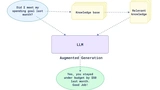
RAG (Retrieval-Augmented Generation) is an innovative architectural pattern that enhances the capabilities of language models by integrating them with external data sources such as documents, knowledge bases, or operational data, without the need for fine-tuning. This technology addresses the challenge of providing accurate and contextually relevant information by executing a series of steps: chunking source documents, embedding each chunk into vector representations, storing these vectors, and retrieving the most similar ones based on a user's query. These retrieved chunks are then used to provide context to the language model, enabling it to generate more informed and precise responses.
On CourseFlix, learners can explore a range of courses related to RAG. For beginners, Introduction to RAG offers a foundational overview, while RAG: Beyond Basics delves into more sophisticated techniques. Those interested in practical applications can consider Build Your Own AI Personal Assistant in TypeScript or Let's Build It: AI Chatbot with RAG in .NET Using Your Data. Whether you're starting out or looking to deepen your expertise, the RAG category has courses to suit various learning paths.