This course provides a detailed examination of using the dotenv module for managing environment variables in JavaScript. You will learn to create nine different environments, including back-end, front-end, SSR, and React Native. The course is suitable for developers at intermediate and advanced levels who want to master the configuration standards of scalable applications. It is also useful for those who use dotenv but encounter challenges in complex scenarios.
Scaling Web App Configuration with Environment Variables
1h 53m 25s
English
Paid
Added to CourseFlix
Scaling Web App Configuration with Environment Variables is a 13-lesson 1 hour 53 minutes self-paced course by Fullstack.io. This course provides a detailed examination of using the dotenv module for managing environment variables in JavaScript.
Course facts
- Lessons
- 13
- Duration
- 1 hour 53 minutes
- Language
- English
- Added to CourseFlix
- February 2025
- Instructor
- Fullstack.io
- Price
- Premium
Prerequisites:
Experience in JavaScript, including ES6, React, and Node.js is required.
Who teaches Scaling Web App Configuration with Environment Variables? Fullstack.io

Fullstack.io is the technical book and course publisher founded by Nate Murray, Ari Lerner, and team — known for the ng-book Angular series, the React Quickly books, and the fullstack React series that anchored a generation of working developers' first deep-dive into modern JavaScript framework material. Fullstack.io has since rebranded to Newline for its newer course catalog.
The book / course catalog covers the modern JavaScript framework landscape — Angular, React, Vue, GraphQL, Node.js — at the level of comprehensive reference works rather than introductory tutorials. The Fullstack.io style is unusually rigorous about the underlying APIs and edge cases that ship projects to production.
The CourseFlix listing under this source carries over 20 Fullstack.io / Newline courses spanning that range. Material is paid; the original platform sold both per-course access and membership tiers. Courses are aimed at developers ready to move past introductory tutorials into the depth of a chosen framework.
What lessons are included in Scaling Web App Configuration with Environment Variables?
0:00
/ #1: Introduction to Course
All Course Lessons (13)
| # | Lesson Title | Duration | Access |
|---|---|---|---|
| 1 | Introduction to Course Demo | 02:11 | |
| 2 | Why Environment Variables | 06:19 | |
| 3 | Environment Variables in Practice | 10:18 | |
| 4 | dotenv flow | 10:31 | |
| 5 | Configuring Your Webpack Builds | 08:29 | |
| 6 | Environment Variables from External Keystore | 13:26 | |
| 7 | How dotenv Flow Interacts with CI / CD | 06:00 | |
| 8 | How to Share Environment Variables with Your Team | 08:13 | |
| 9 | Environment Variables in React Bundles | 10:56 | |
| 10 | Environment Variables in SSR | 14:15 | |
| 11 | Why We Can’t Use dotenv for Babel | 04:17 | |
| 12 | React Native dotenv / Babel Setup | 17:27 | |
| 13 | Conclusion and extra resources | 01:03 |
Watch the other 12 lessons
One payment unlocks this course and every other premium course. No auto-renew.
See plansWhat courses are similar to Scaling Web App Configuration with Environment Variables?
 Updated 5mo ago
Systems Thinking in the AI Era, Course 1
By: Kay AshaoluStudy the universal principles of system design for AI applications and platforms. Apply the knowledge to develop complex digital systems and manage them.4h 22m Updated 7mo ago
Latency. Reduce delay in software systems
By: Pekka EnbergExplore how to reduce software latency using modeling and optimization techniques. A practical guide to eliminating latency from an expert in the field. Updated 1mo ago
Clean Code: Writing Code for Humans
By: PluralsightA focused course on writing code for the humans who'll read it later, not just the compiler: clarity, readability, maintainability.3h 10m FreeUpdated 3y ago
Clean Code
By: Udemy, Academind Pro (Maximilian Schwarzmüller)As a developer, you should be able to write code which works - of course! Unfortunately, a lot of developers write bad code nonetheless - even though the code w6h 41m2/5 FreeClassic
The System Design Masterclass
By: Arpit BhayaniA masterclass that helps you become great at designing scalable, fault-tolerant, and highly available systems. This is a prime and intermediate-level cohort-bas43h 13m4/5 Updated 1mo ago
Fundamentals of Networking Engineering
By: Udemy61-lesson networking fundamentals for backend engineers: TCP/IP internals, protocol selection, and real performance optimization.18h 6m5/5 Updated 1mo ago
Web Application & Software Architecture 101
By: Shivang SarawagiA beginner-friendly look at web application and software architecture, covering client-server, microservices, scalability, and fault tolerance.5/5 Updated 2y ago
Serverless Handbook for frontend engineers
By: Swizec TellerServerless Handbook is a book for frontend developers that provides a detailed explanation of serverless architecture. Over 360 pages, it covers topics such as.
More courses by Fullstack.io
 Updated 3y ago
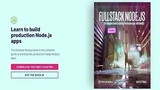
Fullstack Node.js: The Complete Guide to Building Production Apps with Node.js
The Fullstack Node.js book is the complete guide to building fast, production-ready Node.js apps Updated 1mo ago
Mastering CSS Layout
Build real CSS layout intuition across 26 lessons, learning to recreate any design with both CSS Grid and Flexbox.1h 27m2/5 Updated 1mo ago
Demystifying Reactivity with Angular Signals
Learn Angular's signals API for state management through small, focused code examples, building from basics to computed values and effects.1h 44m Updated 1mo ago
Next.js Complex State Management Patterns with RSC
Untangle state management in Next.js Server Components across 19 lessons, covering client vs. server component patterns from the ground up.2h 56m5/5 Updated 3y ago
Fullstack ASP.NET Core and React Masterclass | Learnify
Learnify is a self-paced, online Masterclass, where you will master ASP.NET CORE and React by building a practical, real-world application from scratch.20h 40m0/5 Updated 3y ago
TinyHouse: A Fullstack React Masterclass with TypeScript and GraphQL
Learn to build a full app with React, TypeScript, Node, and GraphQL. You build features step by step and use clear patterns in a real project.30h 50m5/5
Frequently asked questions
What prior knowledge or skills are required for this course?
This course is designed for developers at intermediate and advanced levels. Participants should have a solid understanding of JavaScript and the fundamentals of web development. Familiarity with back-end and front-end workflows, as well as experience with tools like Webpack and Babel, will be beneficial. Prior experience with environment variables and the dotenv module is helpful but not essential, as the course will cover these topics in depth.
What specific projects or configurations will I learn to build?
The course focuses on creating and managing environment configurations across nine different environments. Participants will learn to apply these configurations to various platforms, including back-end setups, front-end applications, server-side rendering (SSR), and React Native projects. The course emphasizes practical applications and real-world scenarios, such as configuring Webpack builds and integrating environment variables with CI/CD pipelines.
Who is the target audience for this course?
The course is aimed at developers who are already familiar with JavaScript and are looking to enhance their skills in managing scalable application configurations. It is particularly suited for those who use the dotenv module but encounter challenges in complex scenarios. This course will benefit developers working on projects requiring robust environment management across different platforms, including back-end, front-end, SSR, and React Native.
How does the scope of this course compare to other configuration courses?
Unlike introductory courses that cover basic environment variable management, this course offers a detailed examination of advanced scenarios using the dotenv module. It covers specific topics like configuring Webpack builds, integrating with CI/CD processes, and managing environment variables in React Native and SSR setups. The course's comprehensive approach to multiple platforms and environments distinguishes it from more general configuration courses.
What tooling or platforms are specifically covered in the course?
The course covers the use of the dotenv module extensively and demonstrates its application across various platforms. Participants will work with tools such as Webpack for build configuration and Babel for React Native setup. The course also explores how environment variables can be managed in different scenarios, including server-side rendering (SSR) and continuous integration/continuous deployment (CI/CD) pipelines.
Is there anything that this course does not cover?
This course does not cover the basics of JavaScript or introductory topics in web development. It assumes that participants already have a working knowledge of these areas. Additionally, while the course covers environment variables extensively, it does not delve into other configuration management tools outside of the dotenv module. The course focuses on advanced scenarios, so it may not be suitable for beginners.
What is the expected time commitment for completing this course?
The course consists of 13 lessons and, although the total runtime is listed as 00:00:00, participants should expect to dedicate several hours to fully engage with the material. This includes time for watching lessons, practicing configurations, and applying concepts to real-world scenarios. The course is structured to allow learners to progress at their own pace, making it flexible for those with varying time commitments.